Muscle fatigue in construction workers often occurs when repeated lifting, carrying, and physical labor place continuous demand on the body’s muscles throughout long work shifts.
Construction work frequently involves lifting materials, operating equipment, and performing repetitive movements. These activities can lead to muscle fatigue when muscles are used continuously throughout the day.
Table of Contents
- Why Construction Workers Experience Muscle Fatigue
- Work Activities That Contribute to Muscle Fatigue
- Ways to Support Muscle Recovery After Work
- Natural Approaches People Use for Muscle Recovery
- Topical Recovery Support
- Safety Considerations
- Frequently Asked Questions
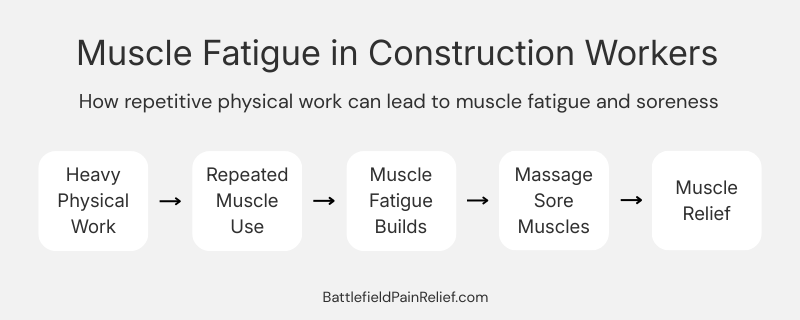
Why Construction Workers Experience Muscle Fatigue
Construction work requires a combination of strength, endurance, and repetitive physical movement. Workers often spend long hours lifting materials, operating tools, climbing, and carrying equipment across job sites.
These activities place continuous demand on large muscle groups throughout the body. When muscles are used repeatedly without enough time to recover, they can become fatigued.
Muscle fatigue may cause feelings of tightness, soreness, or reduced strength, especially after long shifts.
Work Activities That Contribute to Muscle Fatigue
Several common construction tasks can contribute to muscle fatigue when performed repeatedly during the day.
- lifting heavy materials such as lumber or concrete
- carrying equipment across job sites
- repeated bending and kneeling
- using tools that require constant grip strength
- working long shifts with limited rest periods
When these activities occur continuously, muscles may gradually become tired and stiff.
Ways to Support Muscle Recovery After Work
After physically demanding work, many people focus on simple recovery habits that support muscle comfort.
- resting muscles after heavy activity
- light stretching to reduce stiffness
- gentle movement to encourage circulation
- hydration to support normal muscle function
Allowing the body time to recover can help muscles gradually return to normal after intense physical work.
Natural Approaches People Use for Muscle Recovery
Many individuals prefer natural recovery methods after demanding physical labor.
Stretching
Stretching can help maintain flexibility and reduce muscle tightness after long workdays.
Massage
Massage is commonly used to relax tight muscles and support circulation in areas affected by repetitive strain.
Balanced Rest and Activity
Alternating rest with light movement can help muscles recover more comfortably after physically demanding tasks.
Topical Recovery Support
Some people apply a pain relief liniment directly to sore muscles after physically demanding work. When tendon or ligament strain is involved, it may also be used alongside a tendon ligament poultice for localized support.
If discomfort involves bruising or minor impacts, a bruise relief liniment may be applied. Some people combine this with an ice substitute poultice as part of their recovery routine.
For muscle tightness after physical work, some people also use a muscle therapy massage oil during massage to help relax fatigued muscles.
Safety Considerations
If muscle fatigue becomes severe, persistent, or interferes with normal work activities, professional medical evaluation may be appropriate. Using proper lifting techniques and taking regular rest breaks may also help reduce muscle strain.
- Pain Relief Liniment – commonly applied to sore muscles after physical work
- Tendon Ligament Poultice – used alongside liniments to support tendons and ligaments
- Bruise Relief Liniment – applied to areas affected by bumps or impacts
- Ice Substitute Poultice – often used alongside bruise relief liniment
- Muscle Therapy Massage Oil – used during massage to help relax tight muscles
Related Articles
- Shoulder Pain From Repetitive Lifting at Work
- Back Pain From Warehouse Work and Repetitive Lifting
- Fast Pain Relief After Standing All Day at Work
Frequently Asked Questions
Why do construction workers experience muscle fatigue?
Construction workers often perform repetitive lifting, carrying, and physical labor for long periods, which can lead to muscle fatigue.
Can long work shifts cause muscle soreness?
Yes, extended periods of physical activity may lead to muscle soreness or tightness due to repeated strain.
What helps muscles recover after construction work?
Rest, stretching, hydration, and massage are commonly used approaches to support muscle recovery after demanding physical activity.


