
0
item(s)
Cart is empty
|
Home
::
|
How to Avoid Back Strain When Lifting at Work | Workplace Lifting Safety
Back strain during workplace lifting often occurs when the lower back muscles experience repeated stress while moving heavy or awkward loads.
Quick Answer:
Back strain from lifting at work often develops when the lower back muscles repeatedly support heavy loads. Using proper lifting mechanics, keeping objects close to the body, and allowing muscles time to recover may help reduce strain during physical work.
Back strain from lifting at work often develops when the lower back muscles repeatedly support heavy loads. Using proper lifting mechanics, keeping objects close to the body, and allowing muscles time to recover may help reduce strain during physical work.
Table of Contents
- Why Lifting at Work Can Strain the Back
- Lifting Mechanics That Affect Back Strain
- Ways to Reduce Back Strain During Work
- Natural Approaches People Use for Muscle Recovery
- Topical Recovery Support
- Safety Considerations
- Frequently Asked Questions
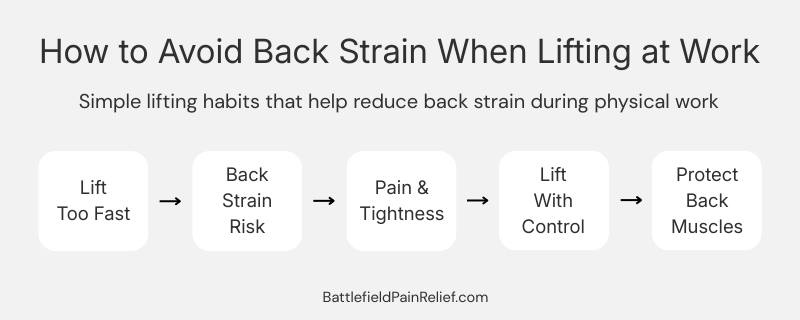
Diagram showing how lifting mechanics and load positioning can influence lower back strain during physical work
Why Lifting at Work Can Strain the Back
Many jobs require workers to lift objects repeatedly throughout the day. This may include lifting boxes, tools, materials, or other loads that place stress on the body.
The lower back muscles play an important role in stabilizing the spine while lifting. When these muscles repeatedly support weight or awkward movements, they may gradually become fatigued.
As muscle fatigue develops, people may notice tightness, soreness, or discomfort in the lower back during or after physical work.
Lifting Mechanics That Affect Back Strain
How a person lifts an object can significantly influence the amount of stress placed on the lower back.
Common lifting habits that may increase strain include:
- bending forward from the waist while lifting
- holding heavy objects far from the body
- twisting the torso while carrying a load
- lifting repeatedly without allowing muscles to rest
When these movements are repeated during long work shifts, the muscles supporting the spine may become overworked.
Ways to Reduce Back Strain During Work
Many workers use simple lifting strategies to help reduce strain on the back during physical work.
- keeping loads close to the body when lifting
- bending the knees rather than the waist
- avoiding twisting while holding heavy objects
- using controlled, steady lifting movements
- taking short breaks during repetitive tasks
These habits may help distribute the workload across multiple muscle groups instead of placing excessive strain on the lower back.
Natural Approaches People Use for Muscle Recovery
After a physically demanding workday, many people use simple recovery practices that help support muscle comfort.
Stretching
Gentle stretching of the lower back, hips, and hamstrings can help maintain flexibility after lifting activities.
Massage
Massage is often used to help relax tight muscles and support circulation in areas affected by repeated lifting.
Rest and Movement Balance
Alternating periods of rest with light movement may help muscles gradually recover after demanding physical tasks.
Topical Recovery Support
Some people apply a pain relief liniment directly to sore muscles after lifting or physically demanding work. When tendons or ligaments feel strained, it may also be used alongside a tendon ligament poultice for localized support.
If lifting tasks lead to minor bumps or bruising, a bruise relief liniment may be applied. Some people combine this with an ice substitute poultice as part of their recovery routine.
For muscle tightness after repetitive lifting, some people also use a muscle therapy massage oil during massage to help relax fatigued muscles.
Related Recovery Tools
- Pain Relief Liniment – commonly applied to sore muscles after physical work
- Tendon Ligament Poultice – used alongside liniments to support tendons and ligaments
- Bruise Relief Liniment – applied to areas affected by bumps or impacts
- Ice Substitute Poultice – sometimes used alongside bruise relief liniment
- Muscle Therapy Massage Oil – used during massage to help relax tight muscles
Safety Considerations
If back pain becomes severe, persistent, or interferes with normal movement, professional medical evaluation may be appropriate. Using safe lifting techniques and allowing muscles time to recover between demanding tasks may help reduce ongoing strain.
Related Articles
- Back Pain From Warehouse Work and Repetitive Lifting
- Why Muscles Get Sore After Physical Work
- Fast Pain Relief After Standing All Day at Work
Frequently Asked Questions
How can I avoid back strain when lifting at work?
Many workers try to keep loads close to the body, bend the knees when lifting, and avoid twisting movements while carrying objects.
Why does my back hurt after lifting at work?
Repeated lifting can place stress on the lower back muscles, which may lead to fatigue and soreness after physically demanding activity.
What helps the back recover after lifting?
Rest, gentle stretching, hydration, and massage are commonly used to support muscle recovery after heavy lifting tasks.